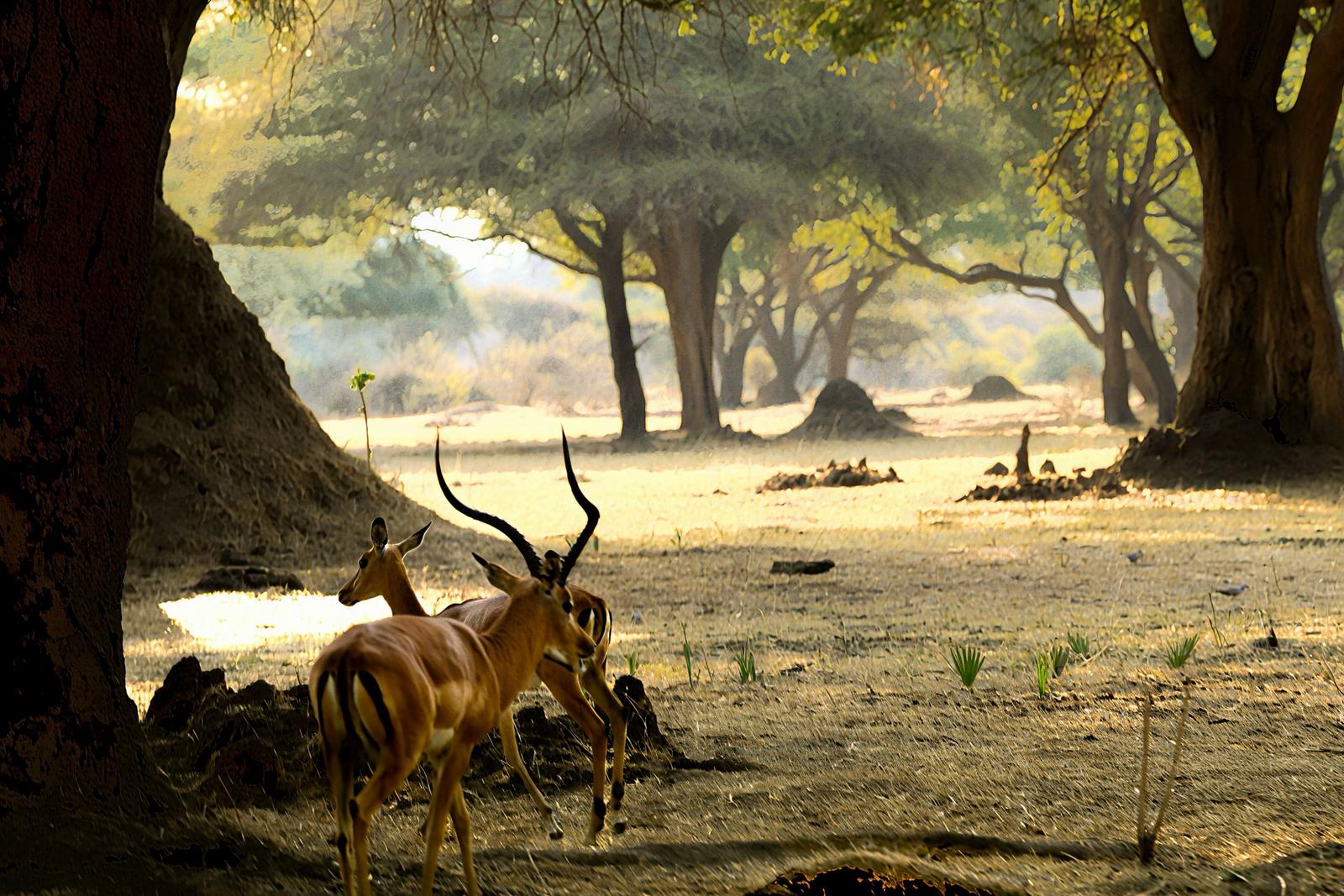
Golden woodland light and graceful movement—there’s a lot to like here.
Short answer: not globally. The scene already leans warm; pushing temperature further will turn the grasses and acacia canopy into a yellow wash and push the impalas toward orange, flattening contrast. If you want more glow, warm the highlights selectively (colour grading or a radial filter over the bright clearing) and keep the shadows neutral or even a touch cooler—this preserves shape and keeps the animals’ coats believable. You’ve made a gentle wildlife image of impala moving through open woodland; the warm, dusty atmosphere is the strongest quality. What do you want the viewer to feel first—the warmth of the habitat or the animals themselves? Your answer should drive how far you push the colour.
TECHNICAL EXECUTION ★★★★
Detail looks solid on the nearer impala’s back and horns, and motion is managed well for what appears to be a slow trot. Exposure is controlled: the bright patches on the ground hold texture and the shadows under the trees are readable. Colour is on the warm side but still natural at this stage; going warmer globally would risk a yellow cast across the frame. There’s no obvious noise or artefacts, and processing appears restrained. To reach five stars, I’d like a touch more micro‑contrast and local presence on the animals to separate them from the similarly toned background.
COMPOSITION ★★★
The pair of impala placed left with space to run into works, and the path of light acts as a loose leading line. However, the large dark tree trunk on the far left is heavy and competes for attention, and the nearer animal presents mostly rump and back—less engaging than a side profile or glance. The second impala’s head is partially obscured and almost merges with the horns and background shapes, reducing clarity. Small bright specks and sticks in the mid‑ground pull the eye. A tighter crop from the left (removing part of that trunk) and a slightly lower, more rightward viewpoint would give the subjects cleaner separation and reduce clutter. How might waiting half a beat for one animal to turn its head have changed the balance?
LIGHTING ★★★★
The dappled morning light is beautiful and suits the habitat—soft enough to keep detail, warm enough to suggest heat and dust. Backlit haze in the distance gives depth and a sense of place. The challenge is the high‑contrast patches on the ground; they are brighter than the animals and grab attention first. A gentle dodge on the impalas and a burn on the brightest patches would guide the eye better. Keep the warmth in the highlights but avoid warming the shadows further, which would reduce tonal separation.
STORY ★★★
There’s a quiet narrative of two antelope moving through their world, and the open space ahead implies a journey. It’s calm rather than dramatic, with no standout behaviour or interaction. Because we see mostly backs, we lose emotional connection—no eye, no gesture, no tension. A fleeting look‑back, a bound across a sunlit patch, or interaction between the two would lift the moment. Consider whether you were aiming for a habitat study or behaviour; that choice affects both timing and framing.
IMPACT ★★★
The image is pleasant and cohesive, with a soothing palette and a sense of place. It doesn’t quite stick in the mind because the key moment is modest and the subjects don’t command the frame. Cleaner separation and a stronger gesture would add bite. If you enhance anything in post, let it be subtle direction of light and local contrast on the animals rather than stronger global colour changes.
CONSTRUCTIVE NEXT STEPS
✓ Keep white balance where it is; instead warm only the highlights using Colour Grading (+5 to +10 on highlights) and cool shadows slightly (−5 to −10) for balance. Use a radial filter over the bright clearing to localise the glow.
✓ Add local presence to the impalas: brush +0.2 to +0.4 exposure, +10 to +20 texture/clarity, and a touch of dehaze to help them lift from the background; burn the brightest ground patches −0.3 EV to reduce pull.
✓ Crop 10–15% from the left to lighten the heavy tree and remove minor edge distractions; consider a subtly wider right crop if available to extend “run‑into” space.
✓ In the field, aim lower and slightly right, and wait for a head turn or step into a sunlit patch. Use AF‑C with 1/1000s or faster to freeze a leap if it happens.
AI Version 2.0