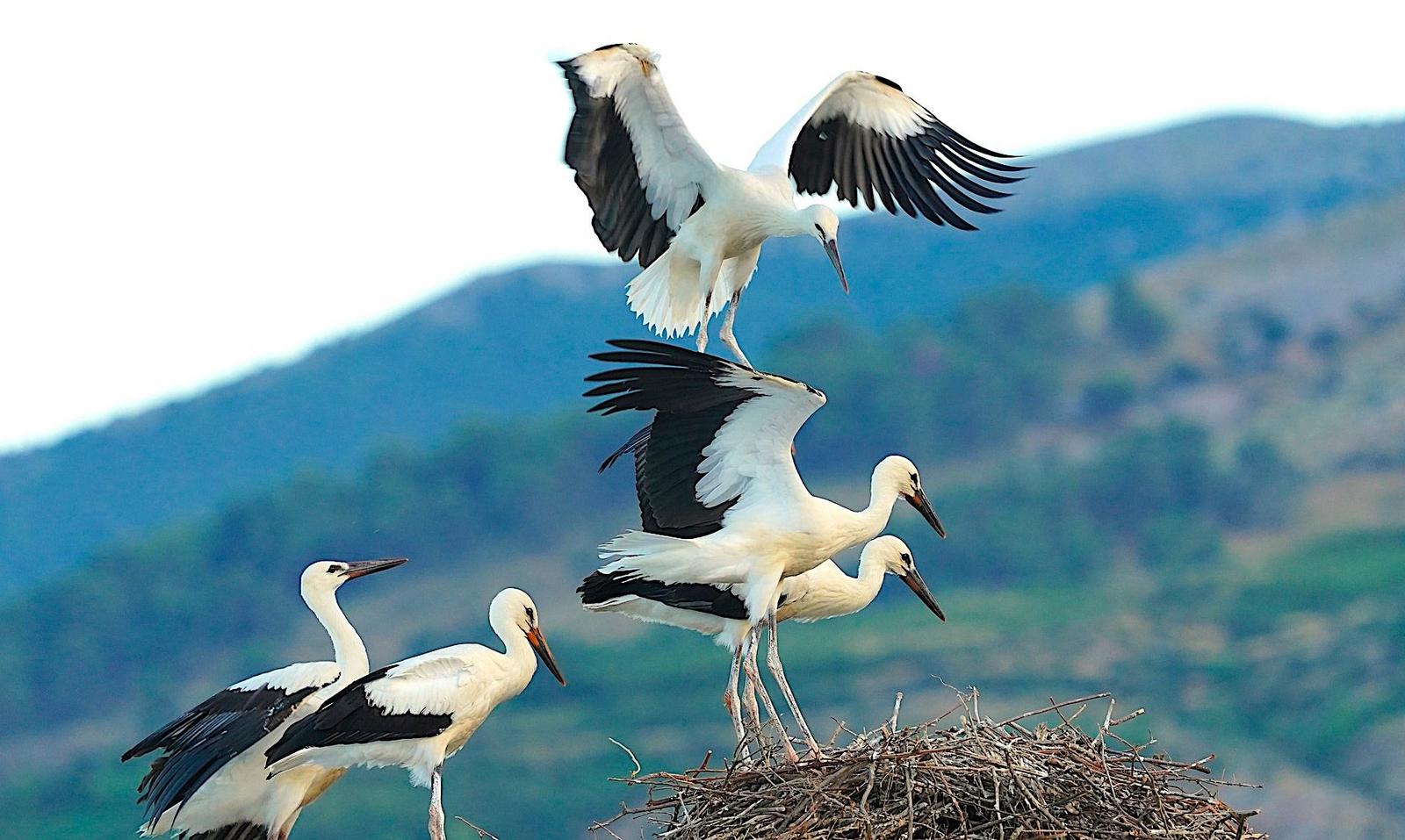
Lively, multi‑bird behaviour caught at just the right beat.
Thanks Raimond — white storks indeed, and you’ve captured a playful, layered moment that feels true to their social nesting life. This sits firmly in wildlife, and your timing with the landing bird stepping onto its sibling is the heartbeat of the frame. The clean, distant hillside keeps attention on the birds while the busy nest tells us where we are. What made you include the two birds on the far left rather than tightening around the landing sequence on the nest? That choice sets the balance of the whole picture, so it’s worth considering what each bird contributes to the story.
TECHNICAL EXECUTION ★★★★
Focus looks solid across the group, with enough crisp detail in the wings and plumage to reward a close look. The exposure is generally well judged for white feathers in soft light; only a few highlights on the folded wings flirt with clipping. The slight motion blur at the very tips of the airborne bird’s wings reads as energy rather than error, though a faster shutter would freeze it completely. Background rendering is smooth and free of distracting noise or artefacts. To reach five stars, I’d want tack‑sharp focus on the landing bird’s eye and absolutely protected whites across all birds.
COMPOSITION ★★★★
The pyramid of birds rising from the nest is strong and naturally leads the eye up to the landing bird. The mountain backdrop is unobtrusive and provides gentle colour separation. However, the two birds at far left feel cramped against the edge, and the partial cut of their legs at the bottom introduces tension that doesn’t add much. A touch more space on the left and bottom, or a step to the right to separate individuals, would clean the frame. Do you think a looser frame prioritising the landing gesture while trimming the left pair would strengthen the story?
LIGHTING ★★★★
Soft, even light suits white storks, keeping detail in the feathers and avoiding harsh shadows. The birds read clearly against the cool, muted hills, which gives a natural palette. The light is honest and functional rather than dramatic, so the scene relies on behaviour for excitement. A lower sun angle or slight backlight could have added rim highlights and sparkle to eyes and wings. Consider whether you could return during first or last light to sculpt more depth without sacrificing detail.
STORY ★★★★
There’s a clear moment: a young stork landing squarely on a sibling while others watch — humorous and recognisable behaviour. The cluster around the nest suggests a busy, social colony and gives context beyond a simple portrait. It stops short of peak drama; a feeding, greeting, or wing‑stretch interaction would elevate the narrative further. Still, it’s an engaging slice of life that feels candid and respectful. Did you shoot a burst — and if so, is there a frame with beaks interacting or more separation between the landing bird’s feet and the back below?
IMPACT ★★★★
The combination of multiple birds, clean background, and a distinct action creates immediate interest and a smile. It’s memorable within common stork‑nest imagery, though not quite singular or iconic. The slight crowding on the left and the safe light keep it from that final punch. With a cleaner edge and a more decisive behavioural peak, this could be a portfolio leader. As it stands, it’s a strong, publishable wildlife moment.
CONSTRUCTIVE NEXT STEPS
✓ For landing/wing action, aim for 1/1600–1/2500s, AF‑C with a small zone on the landing bird; let ISO float to maintain speed while preserving feather detail.
✓ Reframe in the field with a bit more room on the left and bottom, or take a half‑step right to separate individuals and avoid cutting legs; decide whether the left pair adds to the story or dilutes it.
✓ In post, gently recover highlights only on the white feathers (local adjustment), add a touch of micro‑contrast to the landing bird’s head, and a subtle dodge on catchlights to make the primary subject pop.
✓ If possible, return at golden hour to catch backlit edges around the wings; a slight change in time of day will add dimensionality without heavy editing.
AI Version 2.1